Three weeks ago, my daily reflection mentioned something I'd completely missed: my friend's mom had been diagnosed with something serious, and he'd told me about it in a text thread I'd read but never processed.
I'd read the message. I remember scrolling past it on a Tuesday night while cooking dinner. I even felt something when I read it — that pang you get when someone you care about shares bad news. Then my timer went off, I plated the food, and by the time I picked up my phone again, the moment was gone. Buried under new messages. Filed away in the part of my brain that says "I'll come back to this" but never does.
When the reflection surfaced it, I felt two things at once: grateful that something caught it, and embarrassed that I needed something to catch it.
The Things That Fall Through
Your brain is extraordinarily good at processing information in the moment. You read a message, you understand it, you feel the appropriate emotional response. The system works perfectly for about 30 seconds.
Then your kid asks for a snack. An email comes in from your boss. Your partner wants to know what's for dinner. And the thing your friend told you — the surgery, the job loss, the relationship trouble, the exciting news about their kid — gets pushed out of working memory and into the void.
This isn't a character problem. It's a bandwidth problem. Research from the University of California found that the average person processes roughly 74 GB of information per day — the equivalent of watching 16 movies. Your brain is constantly triaging, deciding what to keep and what to drop. And it turns out, the things that matter most to your relationships are often the first to go, because they don't have a deadline attached to them.
Nobody sends you a calendar invite for "ask Jake about his mom's diagnosis." There's no Slack notification that says "Sarah mentioned she's feeling lonely — follow up." These moments exist in a category your brain labels "important but not urgent," which in practice means "forgotten by morning." Research on journaling about relationships shows that writing these things down moves them from short-term to long-term memory — but most people never do.
What a Daily Reflection Actually Looks Like
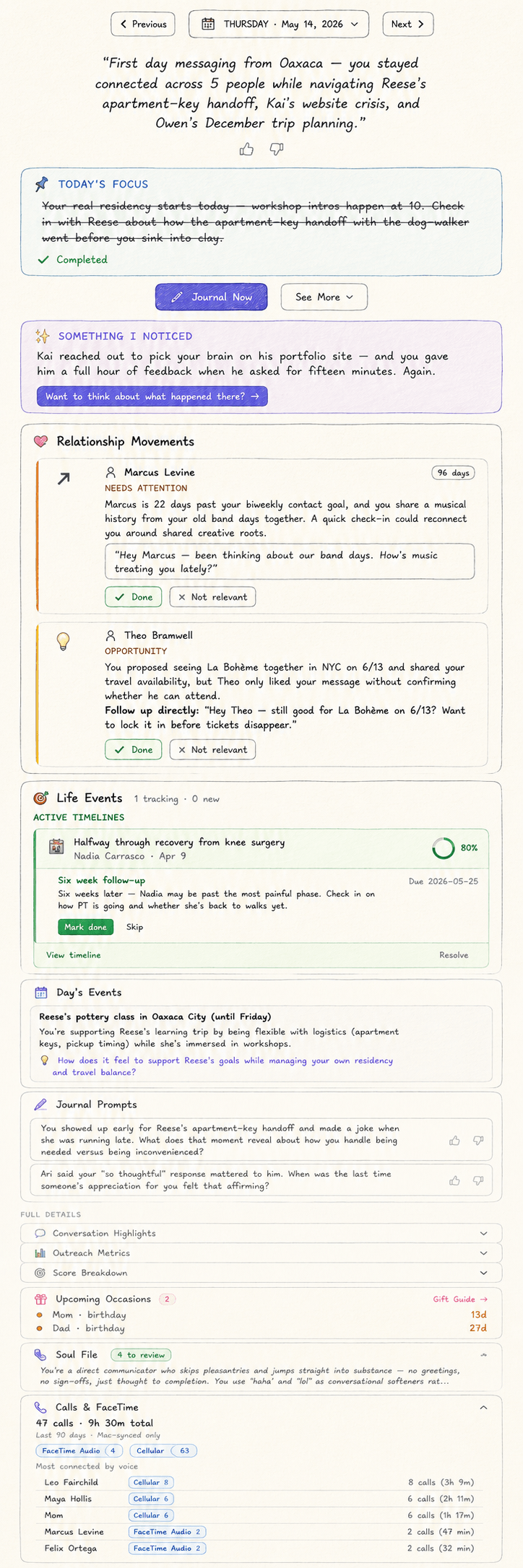
People hear "AI analyzes your messages" and picture a dashboard with charts and scores. Something clinical. Something that feels like a performance review for your social life.
It's not that.
Here's what a real daily reflection sounds like: "You and Devon had a longer conversation than usual yesterday. He opened up about feeling stuck at work — he's been thinking about whether to stay or start looking. This is the third time in two weeks he's brought up work stress. You also had a brief exchange with your sister about weekend plans, and your college roommate sent a photo of his new apartment that you haven't responded to yet."
That's it. No score. No red/yellow/green status indicators. No "you should text these 5 people today." Just a clear, honest summary of what's actually happening in your relationships — written like a journal entry, not a report card.
Sometimes I read it and think "yeah, I know all that." And sometimes it surfaces something like the message about my friend's mom, and I feel a jolt of recognition: I would have missed that.
The Moments That Matter Most
Here's what I've noticed about the moments that actually define friendships: they're almost always small, easy to miss, and impossible to recover if you wait too long.
Your friend mentions she's nervous about a presentation next week. If you text her Thursday night wishing her luck, you're a great friend. If you text her three weeks later saying "oh, how did that thing go?" — it's too late. The moment passed. She needed you Thursday.
Your brother mentions he and his girlfriend are going through a rough patch. If you check in the next day, he opens up. If you forget and ask about it a month later, he says "oh, we're fine now" and the window for connection closes.
These are the moments that separate the friends who show up from the ones who mean to. And the difference between them isn't caring — it's timing.
The people who show up at the right moment aren't more caring than you. They just noticed. They retained the detail long enough to act on it. And in a world where every brain is drowning in 74 GB of daily information, noticing is the hardest part.
My Embarrassment Turned Into Something Else
After the reflection caught my friend's message about his mom, I texted him that night. It had been almost three weeks since he'd told me. I didn't pretend I'd just seen it. I said something like: "Hey — I've been thinking about what you told me about your mom. I'm sorry I didn't reach out sooner. How is she doing?"
He called me twenty minutes later. We talked for an hour. It was one of the best conversations we'd had in months.
He didn't care that I was late. He cared that I showed up.
That's the thing about these moments — they have a longer window than you think, as long as you bring specifics. A generic "hey, how are you?" three weeks later means nothing. But "I've been thinking about your mom" means everything. It means you were paying attention, even if you were slow about it.
What You Notice Changes What You Do
I've been using Amicai for months now, and the biggest change isn't that I text more people. It's that I text better. I show up with context instead of small talk. I ask about real things instead of defaulting to "we should hang out soon."
The AI doesn't tell me who to talk to. It doesn't guilt me into reaching out. It just makes sure the important things my friends tell me don't disappear into the noise of daily life. It's not a CRM for friends — it's closer to a photo album that helps you remember.
Some mornings I read the reflection and nothing stands out. Some mornings it catches something that would have slipped through completely — a friend going through a hard time, a life event I'd forgotten, a conversation that deserved a follow-up I never sent.
Those are the mornings that matter. Not because the technology is impressive, but because the alternative was missing it entirely. And missing the moments that matter is how friendships quietly end. The goal isn't more texting — it's better texting.